

10 Essential Skills for Your First Liveaboard Dive Trip
Ten practical skills worth sharpening before your first liveaboard — from hovering hands-free to shooting a DSMB — plus what to sort out before you book.
A liveaboard week is the best value in diving: more dives, fewer crowds, and reefs that day boats simply cannot reach. It is also a trip where small gaps in your skills show up fast. On a day boat you can sit out a dive, borrow a spare fin, or eat lunch on dry land while you think things through. Out at sea you are on the same deck with the same people for a week, often with no land in sight, and the schedule keeps moving.
None of the ten skills below are exotic. Most were taught on your open water course and have simply gone unpractised since. A little work on them before you travel is the difference between a week spent coping and a week spent enjoying yourself.
Hover and Trim: Skills One and Two
Buoyancy underpins everything else afloat. When you can hold a depth without touching the inflator, you use less air, see more marine life, and stop bumping the reef. The test is straightforward: can you hover at five metres for a three-minute safety stop with your hands still and your breathing normal? If you drift up and down by a metre, keep working at it.
Trim matters just as much. Horizontal, fins behind you, knees slightly bent — that position cuts drag, keeps you off the coral and makes every kick count. Practise in a pool or on a shallow shore dive with no camera and nothing to look at but your own depth gauge. Add air in small amounts, wait, then adjust. Early, gentle corrections beat big bursts every time.
Mask, Regulator and Air-Sharing Drills
Mask clearing, mask removal, regulator retrieval and a controlled ascent while sharing air are all standard skills that plenty of divers last performed on their certification course. On a liveaboard you may need them for real: a fin strap that flicks your mask off, a free-flow at 25 metres, or a buddy who runs low at the far end of a reef.
- Remove and replace your mask at depth, then clear it without surfacing.
- Rehearse the regulator sweep: reach back, find the hose, sweep forward, purge, breathe.
- Run a simulated air-share ascent from 15–20 metres, swapping donor and receiver roles with your buddy.
Agree your air-sharing sequence before every dive — who donates, which second stage you take, and what signal means "I am out". Confusion costs seconds you may not have.
Boat Entries, Current and Shooting a DSMB
Liveaboards mean small tenders, moving decks and entries you do not always get to choose. Giant strides, backward rolls, negative entries into current and a controlled exit onto a rolling platform are all worth rehearsing before you go. Hand your camera or torch up before you climb the ladder, and keep your regulator in until you are sitting down.
Drift diving is where a delayed surface marker buoy earns its place in your kit. Deploying one from depth, in current, while holding your buoyancy is one of the most useful skills in recreational diving and one of the least practised. Do it in calm water until it is automatic: unclip, inflate orally at depth, hold the spool lightly, let the line run, control your ascent, then top up at the surface. A tangled spool or a bag that drags you upward is a poor start to a safety stop.
Navigation and Night Diving
On many liveaboards you dive without a guide, or with one guide leading six divers along a wall. Basic compass work — a square, a reciprocal course — plus natural navigation (sun angle, reef shape, sand channels, depth) will bring you back to the mooring line. If you have always let someone else lead, spend a whole dive doing it yourself.
Torch skills after dark
Night dives are a liveaboard staple. Try your torch on a day dive first: keep the beam low and wide, never shine it in your buddy's eyes, and agree signals you can read without a free hand. Know how to signal with a torch against your palm, and check the battery before every dive — a flat torch is the most common night-dive problem there is. Keep your light in your buddy's field of view and theirs in yours.
Plan the Dive, Then Dive the Plan
Liveaboard briefs are detailed: maximum depth, maximum time, current direction, entry and exit points, turn pressure. Learn to write your own plan on a slate — depth, time, gas, contingency — and stick to it rather than following the group deeper because everyone else is.
Air consumption is mostly about relaxation, streamlining and warmth. Slow down, breathe from your diaphragm, stop finning when you do not need to, and stay warm; a good hood and a well-fitted suit make more difference than any clever technique. Know your own numbers: what you use on a typical 20-metre dive, and what you need for the ascent and safety stop.
Finally, know your kit. Strip and reassemble your regulator, change a fin strap, and pack spare O-rings, a mask strap and torch batteries. At sea there is no dive shop round the corner, and a small fault you can fix on deck saves a dive.
Before You Book
Three or four days of back-to-back diving is a different proposition from a fortnightly club trip, so build up to it. A refresher session with an instructor if you have not dived for a year, twenty or so logged dives, and a couple of consecutive dive days locally will do more for your week than any new piece of equipment.
- Hover hands-free at five metres.
- Hold a horizontal, still trim.
- Remove, replace and clear your mask at depth.
- Share air and ascend under control.
- Enter and exit a boat in swell.
- Dive in current and stay with your buddy.
- Shoot a DSMB from depth.
- Navigate a reef and back to the line.
- Dive confidently at night with a torch.
- Plan a dive on gas, not guesswork.
Ask a dive centre or instructor to run through any of these with you — most will happily build a session around them. If you have a medical condition, take medication, or have had surgery or an illness since your last dive, get a doctor's opinion on your fitness to dive rather than relying on a forum. Then pack light, sleep on the flight, and let the boat do the rest.
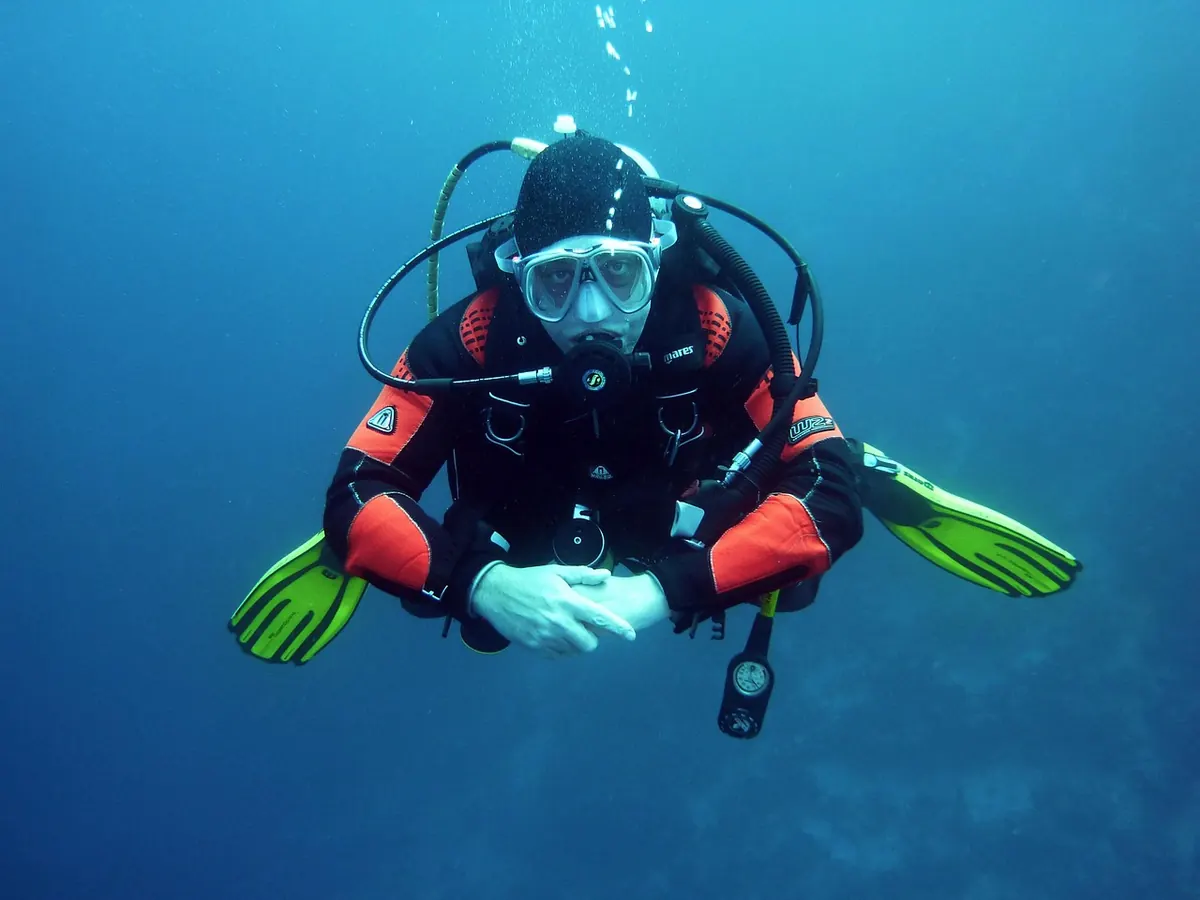
Photo: joakant / Pixabay